
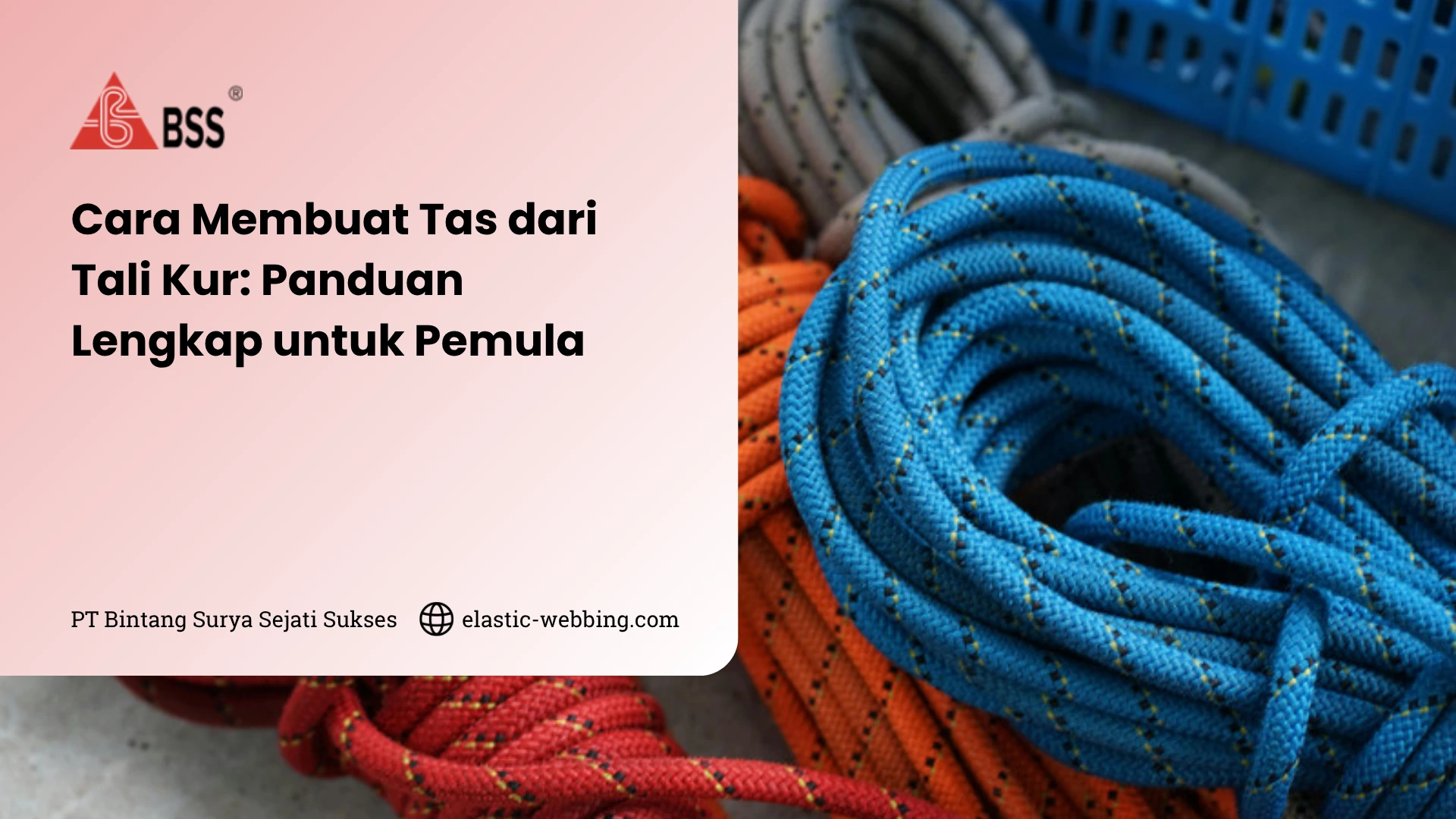


Understanding various ways to make bags from kur cord can be beneficial for those who want to create aesthetic yet functional handmade crafts. Not only as a hobby, this activity can also open opportunities for income.
Although it may seem complicated at first, the process can be learned gradually through basic knotting techniques that are easy for beginners to understand. In this article, you will find a complete, systematic guide to help you achieve neat and durable results.
What Is Kur Cord?
Kur cord is a type of rope originally widely used in scouting activities. As the world of handicrafts has developed, this material has become increasingly popular because it can be used to create various attractive products, especially bags with elegant designs.
Compared to macramé rope, which is generally made from coarse-textured cotton, kur cord is made from polyester or nylon. This makes its surface smoother, more slippery, and slightly glossy, enhancing the aesthetic value of woven products.
These characteristics make bags stronger, more durable, and comfortable for long-term use. In fact, techniques using this type of cord have been known since the 13th century and are considered one of the early foundations of macramé techniques that continue to evolve today.
Types of Kur Cord Commonly Used
Before starting to make a bag, you need to understand the types of kur cord available on the market. Each type has different characteristics that affect both appearance and comfort during weaving.
1. Polyester Kur Cord
Polyester kur cord has a smooth, glossy surface. This makes the woven result look neater and gives the bag an elegant appearance.
In addition, polyester material is quite strong, making it suitable for various bag designs, from simple to complex patterns.
2. Nylon Kur Cord
Nylon kur cord is also a popular choice because it offers excellent strength for carrying heavy loads.
Its surface is still smooth and shiny, resulting in attractive-looking bags. Due to its durability, this type is often used for everyday bags.
3. Satin Kur Cord
Satin kur cord, also known as Chinese cord or rattail cord, is a synthetic cord made from nylon or polyester with a smooth, glossy surface.
These characteristics make it look more elegant and comfortable to use in various craft projects.
How to Choose the Right Kur Cord for Bags
Choosing the right kur cord will make the crafting process easier and result in a stronger, more attractive bag. Consider the following before purchasing:
- Choose a cord with suitable elasticity so it is easy to shape into knots
- Match the cord color with your bag design or pattern for a harmonious look
- Ensure the cord has strong durability to support weight during use
- Consider the quantity needed; larger bags require more cord and will be heavier
- Use a thicker cord so knot details are visible and the weave looks neater
Tools and Materials for Making Kur Cord Bags
Good preparation helps you work more efficiently without interruption due to missing tools. Proper equipment also ensures neater, stronger, and more durable weaving results.
1. Kur Cord as the Main Material
Kur cord is the main material in bag making. It is usually made from polyester or nylon, giving it a smooth and slightly glossy surface. This makes it visually appealing while also strong enough to carry weight.
Choose colors according to your desired design. Use a single color for a minimalist look, or combine multiple colors for a more attractive pattern.
The length of cord needed depends on the bag size—the larger the bag, the more cord required.
2. Needle, Scissors, and Supporting Tools
Besides kur cord, several supporting tools are also essential:
- Scissors: Used to cut cord to the required length. Sharp scissors produce cleaner cuts and make weaving easier.
- Lighter: Used to slightly melt cord ends to prevent fraying and to join new cords during the process.
- Needle and thread: Used to join woven parts and attach lining for a neater interior.
- Lining fabric (furing): A fabric layer placed inside the bag to protect items and improve overall finish.
3. Additional Accessories to Beautify the Bag
After the main structure is finished, you can add accessories to enhance appearance and functionality:
- Closures: zippers, magnetic snaps, or Velcro
- Decorative elements: beads, buttons, decorative flowers, or bag charms
- Straps: handles or shoulder straps for usability and comfort
Also Read: What Is Tali Kur (Drawcord)? Materials, Functions & Industrial Applications
How to Make a Kur Cord Bag for Beginners
Making a kur cord bag requires precision, but no prior experience is necessary. Follow these steps:
1. Decide the Bag Model
First, determine the bag model to estimate cord requirements and difficulty level.
Beginner-friendly models include:
- Hand bag
- Tote bag
- Sling bag
- Clutch
- Pouch
Choose simple patterns such as fish scale patterns, which are easier to learn yet still look elegant.
Once familiar, you can try flower, diamond, diagonal, shell, or arrow patterns.
2. Make Basic Knots
Basic knots are the foundation of the entire bag-making process.
Steps:
- Prepare two cords of equal length (about 2 meters each)
- Fold both cords in half to create four strands
- Label strands 1 to 4 from left to right
- Move strand 4 behind strands 2 and 3 toward strand 1
- Place strand 1 behind strand 4
- Insert strand 1 into the loop between strands 3 and 4
- Pull strands 1 and 4 tightly to form a solid knot
- Repeat until knots are consistent
3. Create the Bag Base
After mastering basic knots, build the base pattern.
Make an even number of knots to keep both sides balanced. The larger the bag, the more base patterns you need.
Ensure all knots are equally tight for a neat and stable structure.
4. Weave the Bag Body
Connect two base patterns together. Take two strands from the left and two from the right, then knot them using the same technique.
Repeat until the structure forms a rectangle or square according to desired height.
If cord runs out, join new cord using a lighter by melting both ends and pressing them together until fused.
5. Make Handles or Straps
After the body is complete, add handles or straps.
Make sure the length is comfortable and securely attached to withstand weight during use.
6. Finishing Stage
Finishing improves both appearance and strength.
- Sew all woven parts together
- Add inner lining (furing)
- Install closure systems (zipper, magnet, or Velcro)
- Add decorative accessories
Basic Techniques You Must Master
Mastering basic techniques ensures neat, strong, and consistent patterns, improving both quality and value.
1. Flat Knot Technique
A fundamental knot used in almost all patterns.
Steps:
- Prepare two cords
- Fold into four strands
- Number strands 1–4
- Cross strand 4 to the left behind strands 2 and 3
- Place strand 1 behind strand 4
- Insert strand 1 into the loop
- Pull tightly
- Repeat as needed
2. Spiral Knot Technique
Used for bracelets, plant hangers, and decorative items.
- Hang four strands
- Middle strands act as anchors
- Use outer strands to knot
- Repeat in one direction to create spiral effect
3. Weaving Technique
Combine knots into structured fabric.
- Take strands from both sides
- Connect using basic knots
- Continue until forming a rectangle or square
- Repeat until desired height is reached
4. Keeping Patterns Neat
- Keep an even number of base patterns
- Maintain consistent knot tightness
- Work carefully and patiently
- Use needle and thread for clean joins
- Seal cord ends with heat
Creative Ideas for Kur Cord Bags
1. Sling Bag
Practical and beginner-friendly. Ideal for daily essentials.
2. Handbag
Elegant and structured, suitable for semi-formal use.
3. Eco-Friendly Shopping Bag
Strong and reusable, reducing plastic waste.
4. Custom Business Bags
High-value products with custom designs for branding or promotional use.
Looking for Quality Kur Cord for Crafting?
As your skills improve, you can turn your creations into valuable products for personal or business use. To ensure neat, strong, and durable weaving results, always use high-quality kur cord.
PT Bintang Surya Sejati Sukses (BSS) has over 30 years of experience as a leading narrow fabric manufacturer in Indonesia, supported by European-standard production technology. If you want to produce professional-quality kur cord bags, BSS is ready to support you.
Also Read: What Is Elastic Rubber Cord? Functions, Types, and Applications