
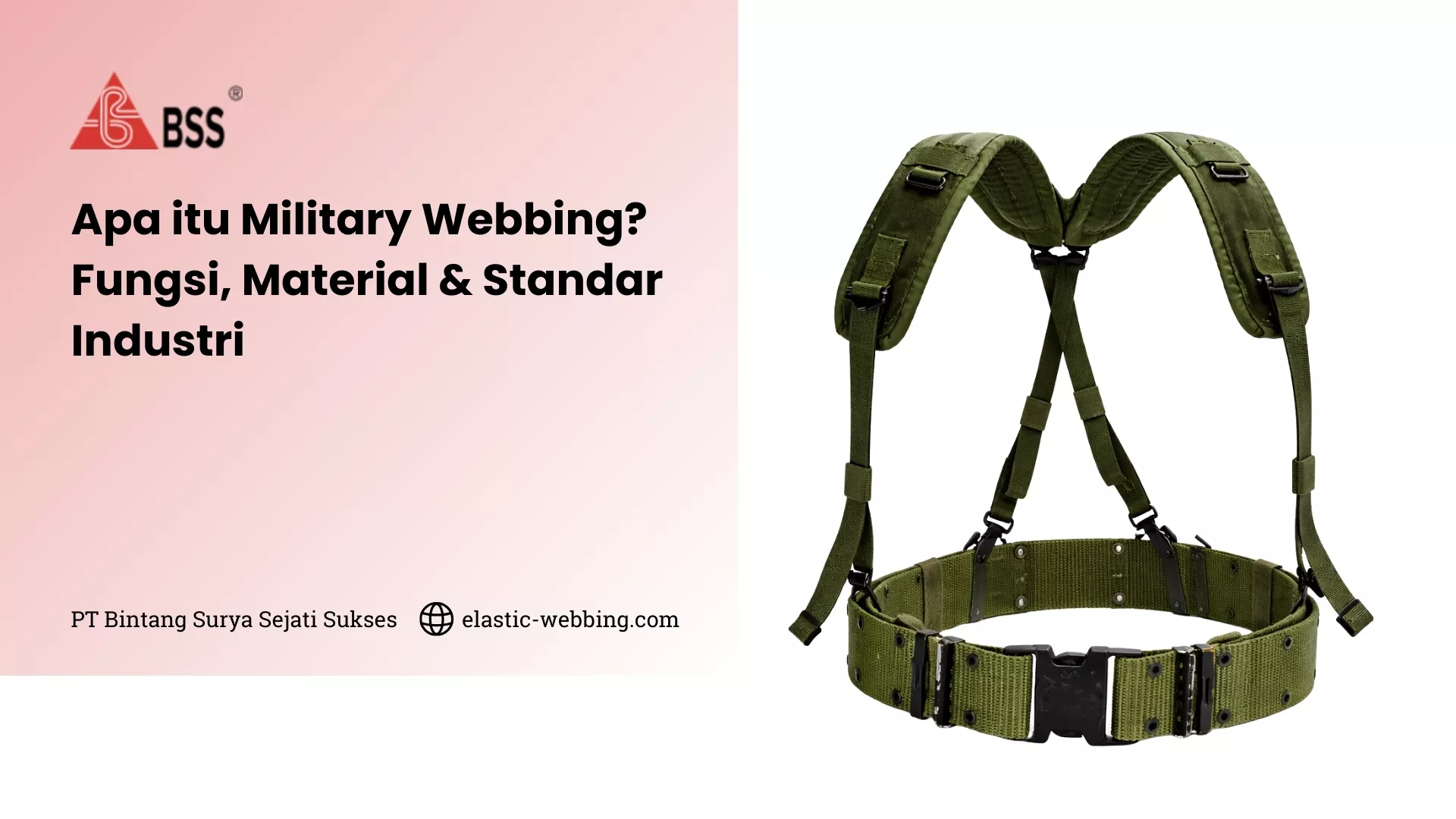


In industries that demand a high level of reliability, not all webbing is created to the same standard. Military webbing is a clear example of how a textile component is engineered to withstand extreme conditions ranging from heavy loads and intense abrasion to harsh weather exposure and demanding working environments.
Unlike general commercial webbing, military webbing is developed with functionality and safety as top priorities. Material failure in military, tactical, or safety applications does not only result in operational losses but can also endanger lives.
As a webbing manufacturer established in 1987, BSS understands that military webbing is not merely a product, but a critical part of a system that must remain reliable over long-term use. This article provides a comprehensive discussion of what military webbing is, its characteristics, the materials used, and how BSS manufactures it to meet both national and international industry demands.
What Is Military Webbing?
Military webbing is a type of webbing with high technical specifications designed for military, tactical, and heavy-duty industrial applications. This webbing functions as a load-bearing component, fastening element, or structural support within various equipment systems.
The defining characteristics of military webbing lie in its consistent strength, durability, and ability to perform under extreme conditions. Beyond being strong, the webbing must also be dimensionally stable and resistant to environmental degradation.
Because of these demands, military webbing often serves as a benchmark for other industrial webbings that require high performance standards, including those used in safety, rescue, and heavy-duty industrial sectors.
Functions and Roles of Military Webbing
Military webbing plays a vital role as a load-bearing component, meaning it directly supports and distributes loads. In many applications, webbing acts as a primary structural element rather than a supplementary accessory.
It is used to secure, support, and stabilize equipment or users. Its roles include harness systems, equipment straps, and load-securing components in tactical and heavy industrial equipment.
Due to its critical function, military webbing must maintain performance even after repeated use under demanding conditions. This is why material quality and manufacturing processes are decisive factors.
Key Characteristics of Military Webbing
One of the primary characteristics of military webbing is high tensile strength with adequate safety tolerance. The webbing must support specified loads without excessive deformation.
In addition, military webbing is designed with strong abrasion resistance. Friction against equipment, hard surfaces, or metal components is common in field applications.
Another equally important characteristic is environmental resistance, including resistance to UV exposure, moisture, and temperature changes. This combination of characteristics distinguishes military webbing from standard commercial webbing.
Baca Juga : 5 Differences Between Nylon and Polyester for Industrial Applications
Materials Used in Military Webbing
Material selection forms the foundation of military webbing production. Each material offers specific characteristics that influence final product performance.
1. Nylon (Polyamide)
Nylon is the most commonly used material for military webbing due to its high tensile strength and good elasticity. This elasticity helps absorb shock loads and reduce sudden stress.
Nylon also offers excellent abrasion resistance, making it suitable for high-friction applications. However, it tends to absorb water, so its use must be carefully matched to the working environment.
In production practice, BSS uses nylon for military webbing applications that require flexibility and high abrasion resistance.
2. Polyester
Polyester is known for its dimensional stability and superior environmental resistance. This material does not easily absorb water and offers good UV resistance.
These characteristics make polyester suitable for long-term use, especially in outdoor and static-load applications. Polyester-based webbing is also relatively easy to maintain.
BSS extensively uses polyester for military and industrial webbing that requires consistent performance across varying weather conditions.
3. High-Tenacity Polyester / Nylon
High-tenacity fibers are high-performance versions of standard polyester or nylon. These materials are engineered to provide higher tensile strength while maintaining efficient fiber diameter.
Webbing made from high-tenacity fibers is used when load and safety specifications exceed standard requirements. Quality control for these materials must be extremely strict.
BSS provides high-tenacity webbing options for clients with specialized technical needs and heavy-duty specifications.
4. Aramid / Kevlar
Aramid or Kevlar is used for extreme applications requiring exceptional heat resistance and strength. This material can withstand high-temperature environments and high-risk conditions.
Due to its cost and specialized characteristics, aramid is typically reserved for military and specialized industrial applications rather than general use.
BSS manufactures aramid-based webbing for projects with advanced safety and performance requirements.
5. Hybrid / Composite Fibers
Hybrid fibers combine two or more types of fibers to achieve specific performance characteristics, such as high strength combined with environmental stability.
This approach allows military webbing to be tailored precisely to client application requirements. However, hybrid designs demand experience and tight production control.
As an experienced manufacturer, BSS utilizes hybrid solutions to meet webbing requirements that cannot be fulfilled by a single material alone.
Structure & Construction of Military Webbing
Beyond material selection, webbing structure has a significant impact on performance. Military webbing typically uses high-density weave patterns to ensure even load distribution.
Flat webbing structures provide stability and ease of integration into various systems, while tubular webbing offers additional protection against internal abrasion.
BSS designs webbing structures based on the product’s end-use, ensuring a balance between strength, flexibility, and long-term durability.
Standards & Specifications for Military Webbing
Military webbing must comply with specific standards and specifications governing tensile strength, production tolerances, and usage safety. These standards serve as references during design and testing processes.
Beyond strength, specifications also address quality consistency across production batches. Traceability and documentation are essential components in B2B industrial processes.
BSS implements internal quality control systems to ensure every webbing product meets the specifications agreed upon with clients.
Applications of Military Webbing Across Various Sectors
Military webbing is not limited to military use alone; it has been widely adopted across sectors that require materials with exceptional strength, durability, and reliability. Its design for extreme conditions makes military webbing highly relevant for industrial, safety, and high-risk working environments.
1. Military & Defense Equipment
In the military and defense sector, military webbing is used as an integral part of load-bearing equipment such as tactical vests, rucksacks, weapon slings, and equipment attachment systems. The webbing must support heavy loads without failure while remaining comfortable for extended use.
Beyond strength, consistency in quality is critical. Military equipment is often deployed in unpredictable field conditions, requiring webbing with stable performance in all situations.
Military webbing is also designed to be compatible with modular systems, enabling flexible equipment configuration and enhancing personnel mobility and operational efficiency.
2. Tactical & Law Enforcement
In tactical and law enforcement sectors, military webbing is used for duty belts, harnesses, and equipment attachment systems. The webbing must support equipment loads without restricting user movement.
These applications demand a balance between strength and flexibility. Webbing that is too rigid may reduce comfort, while overly flexible webbing can compromise equipment stability.
Abrasion resistance and durability under daily use are also essential factors, as law enforcement equipment is used continuously and must deliver long service life with consistent performance.
3. Safety & Rescue Equipment
Military webbing is widely adopted in safety and rescue equipment such as rescue harnesses, lifelines, and fall-arrest systems. In these applications, webbing directly protects user safety.
Webbing for this sector must comply with strict safety standards and provide sufficient safety margins. Material failure in emergency situations can have fatal consequences.
In addition to tensile strength, factors such as visibility, ease of inspection, and resistance to extreme environments are critical considerations in rescue applications.
4. Outdoor & Heavy-Duty Industrial Applications
Beyond military and safety contexts, military webbing is also used in outdoor and heavy-duty industrial sectors that demand highly durable materials. Applications include equipment securing, support systems, and safety components in extreme working environments.
Heavy industries often expose webbing to intense abrasion, weather exposure, and long-term static loads. Military webbing meets these demands more reliably than standard commercial webbing.
Its use in these sectors enhances workplace safety while extending equipment service life, delivering long-term operational efficiency.
Military Webbing vs Commercial Webbing
The primary differences lie in technical specifications and quality control. Military webbing has tighter tolerances and is tested for extreme conditions.
Commercial webbing is generally designed for general-purpose use with more flexible standards. For high-risk applications, military webbing offers superior reliability.
Although military webbing may have a higher initial cost, it delivers long-term efficiency through extended service life and improved safety.
How BSS Manufactures Military Webbing
As a webbing manufacturer since 1987, PT Bintang Surya Sejati Sukses (BSS) produces military webbing using a real-industry, application-driven approach. The production process is carried out with consistent control over materials, structure, and quality.
BSS works closely with clients to define material specifications, construction methods, and standards that align with the final application. This approach ensures that the resulting webbing is fully functional and reliable.
With production capabilities serving both national and international markets, BSS is ready to become a strategic partner in supplying high-quality military webbing across various industrial sectors.
Baca Juga : What Are Webbing Straps? Types, Materials & Industrial Applications