
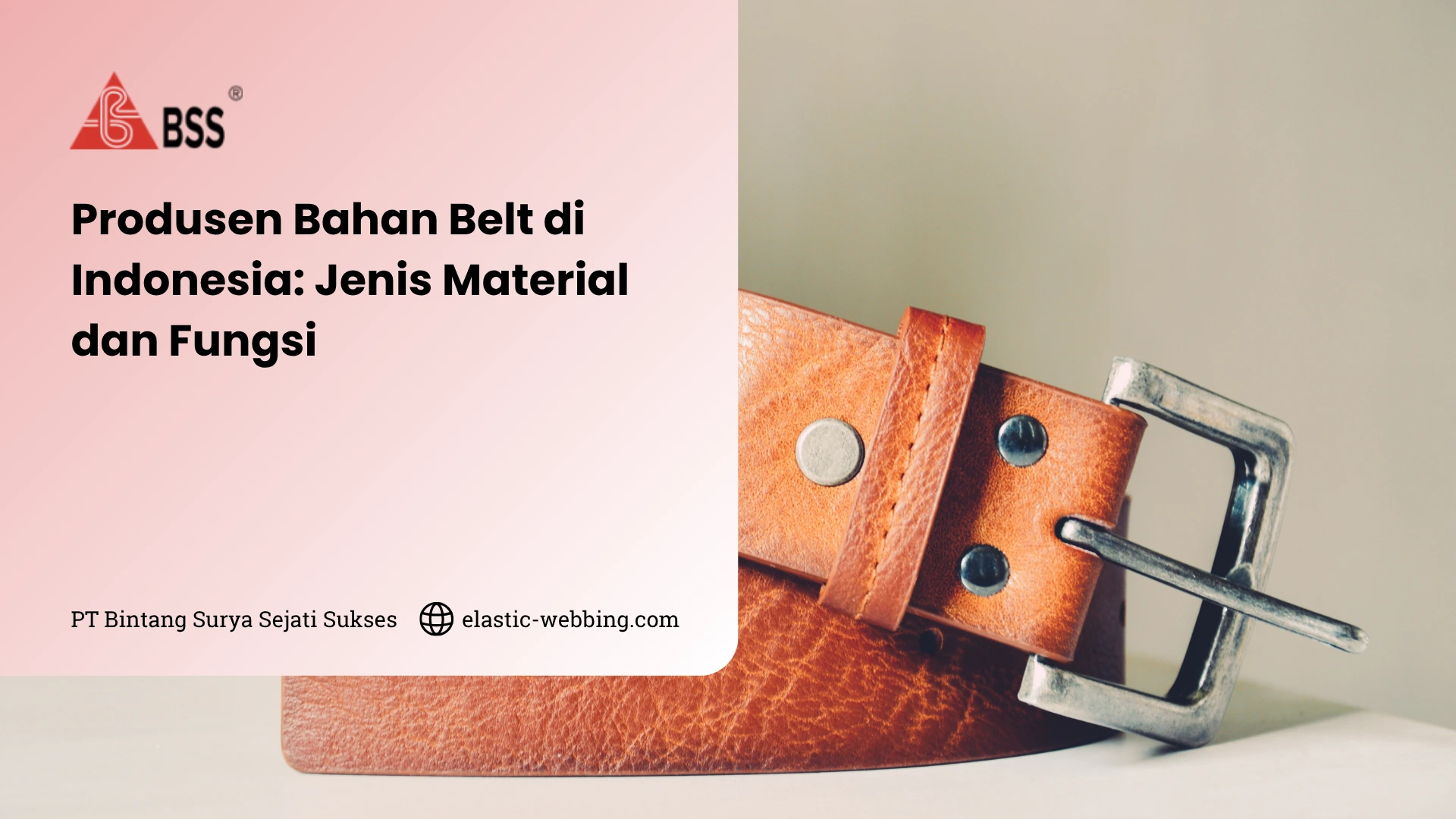


The belt industry continues to grow to meet the needs of various sectors. As a result, belt material manufacturers in Indonesia offer an increasingly diverse range of materials with different characteristics and functions.
Available materials include cotton, nylon, polyester, and elastic rubber, each offering different levels of strength and durability. These materials also undergo manufacturing processes using modern technology to meet industrial requirements.
What Are Belt Materials?
Belt materials are materials used to make belts, tapes, or fastening components for specific purposes. Industries use these materials for power transmission, material handling, fastening, and protection.
In general, belt materials can be divided into materials for mechanical applications and webbing. Both have different characteristics and manufacturing methods depending on their intended use.
1. Industrial and Mechanical Belts
Industrial belts support machinery operations and material-handling processes. Examples include V-belts, which transmit rotational power, and conveyor belts, which move various materials.
The materials used to manufacture these belts must have sufficient strength and abrasion resistance. These characteristics help belts operate reliably under loads and during continuous use.
2. Webbing and Narrow Fabrics
Webbing is a narrow strip made from interlaced yarns through weaving, knitting, or braiding processes. Although relatively thin, this material can provide high tensile strength.
Industries use webbing for various applications, including belts, fastening straps, safety equipment, and accessories. Manufacturers can customize its width, thickness, color, and construction to suit specific applications.
Types of Materials Used to Make Belts
The following materials are commonly used to produce belts and webbing for various applications.
1. Cotton
Cotton is a natural fiber with a soft texture that feels comfortable against the skin. It can be used to manufacture tapes, ribbons, and belt components that require natural fiber characteristics.
In addition to its comfort, cotton absorbs moisture well. Therefore, it is more suitable for applications that do not require extreme resistance to water or abrasion.
2. Nylon
Nylon is a synthetic fiber with high tensile strength and abrasion resistance. These characteristics make it suitable for applications that require strong and flexible materials.
Nylon is widely used in webbing for safety equipment, outdoor products, and tactical gear. It also offers good flexibility for belts that need to withstand demanding use.
3. Polyester
Polyester offers good resistance to abrasion, weather conditions, and ultraviolet (UV) exposure. It also tends to maintain dimensional stability, making it less likely to change shape during use.
These characteristics make polyester suitable for webbing slings, fastening straps, and various industrial equipment. It can also maintain its performance in relatively demanding environments.
4. Elastic Rubber
Elastic rubber can stretch and return close to its original shape. Manufacturers can combine it with textile yarns to produce flexible materials.
This material is widely used in clothing waistbands, accessories, and products that need to conform to the body’s shape. Structures such as woven jacquard elastic also allow manufacturers to incorporate specific patterns or designs.
What Is a Webbing Belt?
Unlike leather belts, webbing belts are generally lighter and more flexible. They can be used for fashion, work equipment, outdoor activities, and certain technical applications.
1. Webbing Belt Structure
A webbing belt consists of interlaced yarns arranged to create a strip with a specific density. Manufacturers can adjust the construction according to the required strength and flexibility.
Yarn density affects the final characteristics of the product. When the construction matches the intended application, the belt can perform more effectively under tension and friction.
2. Webbing Belt Applications
Webbing belts can be used as waist belts, fastening straps, and components of safety equipment. Industries can also customize their colors, sizes, and designs for specific applications.
In the fashion sector, products can feature a wide variety of patterns and colors. Industrial applications, meanwhile, prioritize strength, stability, and the material’s ability to withstand loads.
Characteristics of High-Quality Belt Materials
The following characteristics can help you choose materials for industrial applications and consumer products.
1. Good Tensile Strength
Materials with high tensile strength can withstand forces when a belt carries a load. This characteristic is particularly important for lifting, fastening, and safety applications.
Manufacturers must match the material’s strength to the expected working load. Choosing the right material helps reduce the risk of damage during use.
2. Abrasion Resistance
Belts frequently experience contact and friction during use. Materials with good abrasion resistance can help extend product life.
This characteristic is particularly important in industrial applications where belts operate continuously. Manufacturers can select suitable fibers and constructions to withstand these conditions.
3. Stability Under Changing Environmental Conditions
Changes in temperature, humidity, and sunlight exposure can affect material properties. Therefore, some applications require materials that can maintain their performance under specific environmental conditions.
Polyester and certain synthetic fibers offer good resistance to environmental factors. However, users should still select materials based on the actual conditions in which the products will be used.
4. Consistent Construction
Consistent construction helps produce belts with uniform dimensions, thickness, and strength. Manufacturers can maintain this consistency through precision machinery and quality inspections.
Processes such as dyeing, heat-setting and finishing, and quality control help maintain product characteristics. Each stage must be properly controlled to ensure the final product meets the required specifications.
Types of Webbing Used for Belts
The following are some common types of webbing used for belts and other equipment.
1. Woven Webbing
Woven webbing is produced by systematically interlacing yarns through a weaving process. This structure creates a strong strip with relatively stable dimensions.
It can be used for bag straps, belts, safety equipment, and industrial applications. Manufacturers can also customize its width and thickness to meet specific requirements.
2. Jacquard Elastic
Jacquard elastic combines an elastic structure with jacquard weaving techniques to create specific patterns. This technique allows manufacturers to incorporate designs, text, or motifs directly into the material’s surface.
Its elasticity makes it suitable for products that require flexibility. The fashion and accessories industries widely use this material to create more visually appealing products.
3. Knitted Elastic
Knitted elastic uses a knitting technique to create a flexible material. This structure produces a relatively soft surface that can adapt to changes in shape.
It is suitable for clothing, accessories, and products that require elasticity. Its flexibility can be adjusted according to the structure and type of yarn used.
4. Braided Elastic
Braided elastic is made by interlacing multiple yarns to create a ribbon-like or cord-like structure. This technique produces a flexible material with elastic properties.
It can be used in clothing, accessories, cords, and various products that need to stretch. Manufacturers can adjust its dimensions and yarn composition to suit product requirements.
What Are the Functions of Belt Materials?
Belt materials serve a wide range of purposes because each type can be designed for different applications. Common uses include:
- Transmitting mechanical power to pulleys using V-belts.
- Moving goods or materials continuously using conveyor belts.
- Manufacturing lifting gear, webbing slings, and body harnesses.
- Producing webbing belts, elastic tapes, trimmings, and lanyards.
- Supporting seating structures through sofa webbing and reinforcing mattress edges with mattress tape.
Read Also: Best Shoelace Tipping Film Manufacturers in Indonesia!
Applications of Webbing Belts Across Industries
Webbing belts are strong, flexible, and suitable for repeated use. As a result, various industries use them for technical applications, safety equipment, and everyday products.
1. Automotive and Manufacturing Industries
The automotive industry uses webbing as a supporting component in various vehicle systems and fastening equipment. Its ability to withstand tension and friction makes it suitable for applications that require high durability.
In manufacturing, webbing belts can also function as fastening straps or support components. Selecting the right material and construction helps maintain safety and stability throughout production processes.
2. Workplace Safety and Load Lifting
The workplace safety sector uses webbing to manufacture body harnesses, webbing slings, and load-lifting equipment. These products require materials with high tensile strength to support loads within their specified limits.
Manufacturers must consider the weave structure, thickness, and fiber characteristics before using webbing for safety applications. Suitable materials help maintain equipment performance under tension and repeated loading.
3. Fashion, Apparel, and Accessories
The fashion industry uses webbing for belts, bag straps, shoelaces, lanyards, and various clothing accessories. This material offers a wide selection of colors, sizes, patterns, and elasticity levels.
Manufacturers can choose cotton, nylon, polyester, or elastic materials according to the product’s characteristics. These variations allow webbing to meet design requirements while delivering the desired functionality.
4. Military and Outdoor Activities
Military equipment requires strong materials that can withstand demanding conditions. Military webbing can be used in bags, tactical vests, fastening equipment, and various field accessories.
Outdoor activities also require materials that can withstand abrasion and intensive use. Manufacturers can customize webbing construction for applications such as rock climbing, travel equipment, and other outdoor activities.
5. Furniture and Home Equipment
The furniture industry uses webbing to support the seating structures of chairs and sofas. Sofa webbing helps support weight while providing flexibility to the seating area.
Furniture manufacturers can select materials based on the required strength and elasticity. Choosing the right material helps maintain furniture comfort and durability over the long term.
6. Medical and Orthopedic Applications
The medical industry uses elastic materials in various body-support products. Examples include elastic bandages, corsets, and orthopedic equipment that require flexibility and the ability to conform to the body’s shape.
Manufacturers must select materials based on their elasticity, comfort, and durability. These characteristics help products provide more consistent pressure or support during use.
Factors to Consider When Choosing Belt Materials
Every application requires different material characteristics. Therefore, you should consider several factors before selecting the most suitable material.
1. Tensile Strength
Tensile strength determines a material’s ability to withstand force without breaking easily. Applications involving heavy loads require materials and webbing constructions that can handle the expected stress.
You should also match the material’s thickness and weave structure to the intended application. These considerations help optimize performance and reduce the risk of damage under load.
2. Material Type
The type of fiber affects the final characteristics of belts and webbing. Nylon offers strength and abrasion resistance, while polyester provides dimensional stability and resistance to environmental exposure.
Elastic materials are suitable when a product requires a high degree of flexibility. Cotton, meanwhile, can be an option for applications that prioritize natural fiber characteristics and comfort.
3. Manufacturing Method
Manufacturing methods influence the shape, density, and characteristics of a material. Manufacturers can use weaving, knitting, crochet, or braiding techniques according to product requirements.
Precision machinery helps maintain consistent webbing width and structure. These processes also enable manufacturers to produce materials with more uniform specifications.
4. Environmental Resistance
Operating conditions can affect a material’s service life. Exposure to UV radiation, humidity, heat, chemicals, and friction should be considered when selecting materials.
You can choose materials according to the working environment and the level of exposure the product will experience. This helps maintain belt performance throughout its service life.
5. Finishing and Material Stability
Finishing processes can help improve dimensional stability and surface characteristics. One example is heat-setting, which helps maintain the material’s shape after manufacturing.
Dyeing should also be considered when a product requires consistent coloring. Quality control at every stage helps manufacturers ensure that materials meet the specified requirements.
Advantages of Using Belt Materials from Local Manufacturers
Local manufacturers can offer advantages in production, communication, and distribution. You may also find materials that are easier to customize for domestic industrial requirements.
1. Easier Production Communication
Working with local manufacturers allows specifications to be discussed more directly. Production teams can more easily coordinate requirements for dimensions, materials, colors, construction, and order quantities.
Clear communication helps reduce errors during manufacturing. Manufacturers can also provide information about material capabilities before beginning large-scale production.
2. More Efficient Delivery
Having production facilities closer to the domestic market can shorten the distribution chain. This can make it easier for companies to manage raw material delivery schedules.
More efficient delivery also helps companies manage inventory. Manufacturers can coordinate production schedules with customer requirements to maintain a planned supply.
3. Support for Custom Requirements
Local manufacturers can customize materials according to product requirements. Adjustments may include width, thickness, color, patterns, fiber type, and elasticity.
Customization provides flexibility for companies with specific product specifications. Manufacturers can also develop samples before proceeding with large-scale production.
4. More Integrated Quality Control
Manufacturers with integrated production facilities can supervise multiple stages within a single production process. These stages may include dyeing, weaving, finishing, and quality inspections.
Consistent control helps maintain material characteristics from one production run to the next. As a result, companies can obtain materials with more stable specifications.
Custom Belts and Webbing for Your Production Needs
Every product has different requirements, so one type of material may not be suitable for every application. Custom manufacturing gives companies greater flexibility to define material specifications in detail.
1. Customizing Dimensions and Materials
Manufacturers can adjust width, thickness, and fiber type according to production requirements. Material options may include nylon, polyester, cotton, and elastic yarns.
These adjustments help companies obtain materials that match their products’ intended functions. Manufacturers can also determine the webbing construction based on strength and flexibility requirements.
2. Customizing Colors and Patterns
Colors can be customized to match brand identity or product design. Manufacturers can also develop specific patterns using jacquard technology to achieve a more distinctive appearance.
Patterns or logos can become part of a product’s visual identity. With the right manufacturing process, these elements can be integrated into the webbing structure for a more consistent appearance.
3. Production Based on Specifications
Companies can communicate their technical requirements before manufacturing begins. Information such as dimensions, materials, colors, quantities, and intended functions helps manufacturers determine the appropriate production method.
Manufacturers can then develop samples to confirm that the specifications meet expectations. This stage helps reduce the risk of inconsistencies before large-scale production begins.
Get High-Quality Belt Materials and Webbing from BSS
PT Bintang Surya Sejati Sukses (BSS) provides a range of narrow fabrics and elastic webbing solutions for industrial applications. Its production technology and customization capabilities allow BSS to tailor materials to specific requirements.
If you need belt materials and webbing for your production processes, contact BSS to discuss material specifications, designs, dimensions, and custom requirements for your application.
Read Also: Velvet Tape Manufacturers in Indonesia: Types, Functions, and Applications