


Behind many textile products, apparel items, and industrial equipment, there is a small component that is often considered trivial yet plays an important role: tali kur (drawcord). From jackets and bags to safety equipment, tali kur functions as a fastening element, an adjustment mechanism, and a supporting component for both design and product functionality.
In an industrial context, tali kur is not merely an ordinary cord. The selection of materials, structure, and production methods significantly affects its strength, durability, and user comfort in the final product. Choosing the wrong type of tali kur can lead to reduced product quality and, in some cases, pose safety risks.
As a narrow fabric manufacturing company established in 1987, PT Bintang Surya Sejati Sukses (BSS) understands that tali kur must be designed according to specific industrial application requirements. This article provides a comprehensive discussion of tali kur, covering its definition, materials, structure, and applications across various industrial sectors.
What Is Tali Kur?
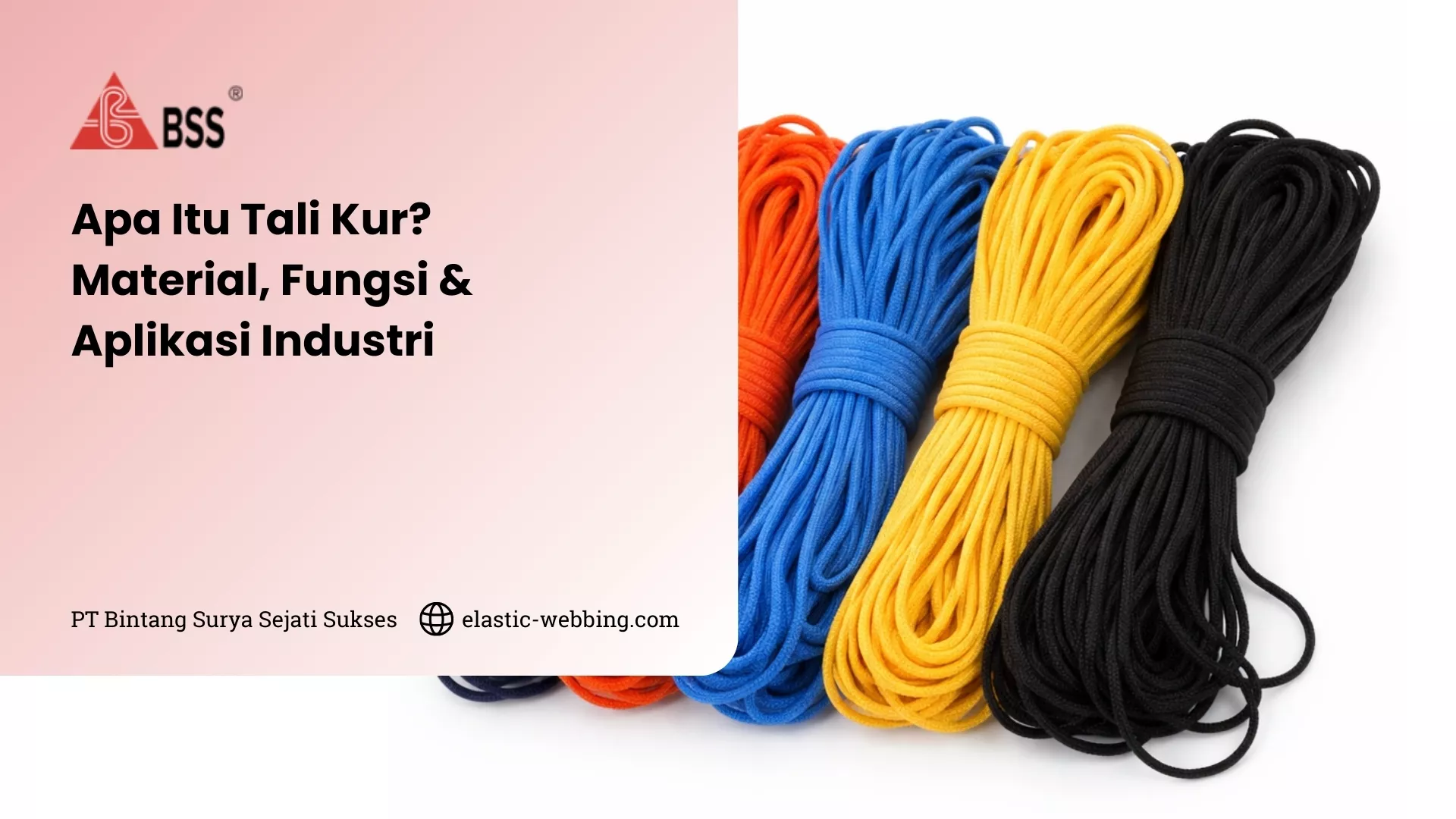
Tali kur is a type of textile cord with a relatively small diameter, commonly used as a fastening, tightening, or opening-adjustment element in various products. This cord is made from a wide range of fiber materials, both natural and synthetic, and is produced using knitting, braiding, or specialized weaving techniques.
Unlike conventional ropes, tali kur is designed for applications that require flexibility, dimensional precision, and a neater appearance. For this reason, tali kur is widely used in apparel products, accessories, and light industrial components.
In modern manufacturing, tali kur is also categorized as part of narrow fabric, referring to textile products with narrow widths that are produced under strict quality control to ensure consistent performance and aesthetics.
Components & Structure of Tali Kur
The structure of tali kur consists of core fibers and an outer layer that work together to provide specific tensile strength and flexibility. This composition determines how the cord responds to loads, repeated pulling, and environmental conditions.
Common construction methods include knitted, braided, and tubular structures. Each structure offers different characteristics—for example, braided cords tend to be more stable, while knitted cords are more flexible and comfortable to the touch.
In industrial applications, the structure of tali kur must be aligned with the function of the final product. For products that are frequently pulled and released, high abrasion resistance becomes a top priority to ensure long service life.
Baca Juga : What Is Woven Tape? Definition, Materials & Industrial Applications
Types of Tali Kur Based on Material
The material used in tali kur plays a critical role in determining strength, flexibility, and resistance to environmental conditions. Each material has technical characteristics that make it more suitable for specific industrial applications.
1. Cotton Tali Kur
Cotton tali kur is known for its soft texture and comfortable feel. This material is commonly used in fashion products and casual apparel that prioritize user comfort.
However, cotton has limitations in terms of moisture resistance and high tensile strength. As a result, its use in industrial sectors is generally limited to non-structural or decorative applications.
2. Polyester Tali Kur
Polyester is the most commonly used material for industrial tali kur due to its excellent dimensional stability. This material is resistant to moisture, mold, and weather changes, making it suitable for long-term use.
In large-scale production, polyester tali kur provides high consistency in quality. This makes it a primary choice for functional apparel, bags, and light industrial equipment.
3. Nylon Tali Kur
Nylon tali kur offers very high tensile strength and abrasion resistance. These characteristics make it ideal for applications that require durability against friction and dynamic loads.
However, nylon tends to absorb more water compared to polyester. In humid environments, this factor must be carefully considered in product design to maintain optimal performance.
4. Polypropylene (PP) Tali Kur
Polypropylene is known for being lightweight and water-resistant. PP tali kur is commonly used in outdoor products and applications where reduced weight is important.
The main limitation of PP is its lower resistance to heat and UV exposure compared to polyester or nylon. Therefore, its use must be matched carefully with the product’s working environment.
5. Elastic / Lycra Tali Kur
Elastic tali kur incorporates elastane or Lycra fibers to provide stretch capability. This type is widely used in sportswear, jackets, and products that require high flexibility.
In industrial applications, elastic tali kur must be designed with controlled elasticity to prevent premature loss of shape after repeated use.
6. High-Performance / Technical Fibers
For specialized needs, tali kur can be manufactured using technical fibers such as aramid or high-tenacity fibers. These materials offer significantly higher strength and heat resistance.
This type is generally used in safety applications or specialized industrial environments that demand maximum performance, despite higher production costs.
Classification of Tali Kur Based on Construction
Based on construction, tali kur can be classified as flat, round, tubular, or braided. Each construction type provides different mechanical characteristics in terms of load handling and flexibility.
Tubular tali kur, for example, has an internal hollow space that makes it more flexible and comfortable to use. Braided cords, on the other hand, offer better shape stability for light structural applications.
Selecting the right construction helps manufacturers ensure that tali kur performs optimally according to the function of the final product.
Applications of Tali Kur Across Various Industries
Tali kur is used in a wide range of industrial sectors with varying functional requirements, from aesthetics to safety considerations. Selecting the appropriate type and specification of tali kur ensures optimal performance and durability in the final product.
1. Fashion & Apparel
In the fashion industry, tali kur is used in jackets, hoodies, pants, and dresses as an opening adjustment element or a design feature. Aesthetic appeal and comfort are the primary considerations.
Consistency in color, texture, and tensile strength is important to ensure the cord aligns with the overall quality of the apparel product.
2. Household & Interior Products
Tali kur is also used in interior products such as curtains, cushions, and decorative accessories. In this sector, visual appearance and resistance to daily use are key priorities.
Materials that are easy to maintain and resistant to deformation are highly favored by interior product manufacturers.
3. Outdoor & Gear Accessories
For outdoor products such as bags and outdoor activity equipment, tali kur must withstand extreme environmental conditions. Polyester and nylon are often selected due to their weather resistance.
The strength and reliability of tali kur are critical to maintaining product functionality and safety.
4. Industrial & Safety Components
In industrial and safety applications, tali kur functions as a fastening component or a supplementary element within safety systems. Here, quality standards and performance testing are mandatory requirements.
The tali kur used must meet specific technical specifications to ensure safe use in industrial working environments.
Differences Between Tali Kur, Webbing & Other Ropes
Tali kur has a smaller diameter and higher flexibility compared to webbing. Conventional ropes, on the other hand, are generally used for heavy loads and structural applications.
Webbing is more suitable for load distribution, while tali kur excels in precision, flexibility, and aesthetics. The choice between these options must be aligned with the product’s intended function.
Quality Standards & Testing for Tali Kur
In industrial production, tali kur must undergo a series of tests such as tensile testing, abrasion resistance testing, and dimensional consistency checks. These tests ensure stable performance across every production batch.
Quality standards serve as an important reference for manufacturers to maintain client trust and ensure product safety.
How BSS Manufactures Tali Kur
As a narrow fabric manufacturer since 1987, PT Bintang Surya Sejati Sukses (BSS) produces tali kur using an industry-driven approach. From material selection and construction design to quality control, every stage is integrated into a unified production process.
BSS provides customizable tali kur solutions according to client technical specifications, serving both domestic and international markets. With decades of experience and consistent quality, BSS is ready to become a long-term production partner for various industrial sectors.
Baca Juga : What Is Sofa Webbing? Functions, Materials & Standards for Furniture